

100,000 Fans Covered by 300 Access Points
EZELINK designed and built stadium-wide WiFi for the Dubai Rugby Sevens — 1.04 million square feet, seven separate networks and 36 retail sub-networks, delivered in a 21-day build window with roughly a third of the hardware a conventional design would need.
A Mini City That Exists for Three Days
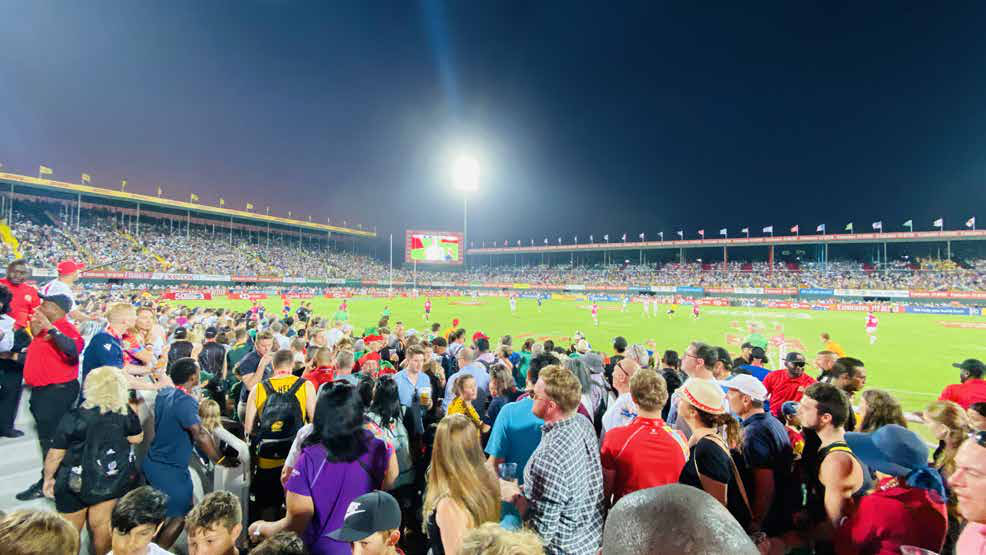
The Dubai Rugby Sevens is the longest-running sports event in the Middle East and the biggest on Dubai's sporting calendar. Over 100,000 people come through the gates, across a 78-acre site that includes the main stadium, six additional rugby pitches, 36 retail outlets, an entertainment area, a VIP area and a management building.
For those few days it functions as a small city — and like a city, almost nothing on it works without the network. Mobile point-of-sale terminals take the money. Security scanners control the gates. Media and photographers file from the touchline. Business systems run the event itself. And forty thousand smartphones sit inches apart in the stands, every one of them trying to transmit.
All of that had to be designed as separate, secure networks on shared infrastructure, deployed inside a build window measured in weeks, and handed to a small IT team who could not be expected to manage hundreds of access points by hand.
- Seven distinct networks: POS, media broadcast, security scanners, business systems, guest and contractor, special events, and fan internet
- 36 retail outlets, each needing its own isolated sub-network
- Severe RF interference from tens of thousands of devices in close proximity
- Hundreds of access points and thousands of users, managed by a limited IT team
- A build window of weeks, against a date that could not move
Fewer Access Points, Placed Properly
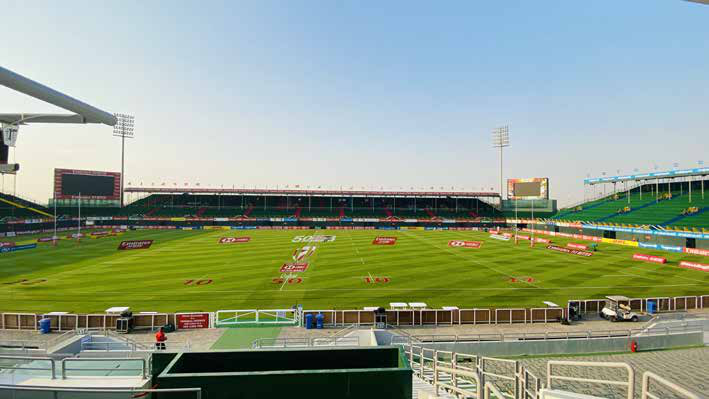
A standard enterprise access point handles 30 to 50 client devices. Ours are engineered to carry up to 300. That single difference changes the entire economics of a stadium deployment — and it is why 1.04 million square feet needed 300 access points rather than close to a thousand.
The design work was where the value sat. Our R&D team modelled the device load and bandwidth requirement for every area of the site separately — stands, pitches, retail, VIP, entertainment, management — then set access point counts and placement against those numbers rather than against a coverage map. Channel assignments and RF power levels were fine-tuned during installation, in the live RF environment, rather than assumed in advance.
On top went dual-band access points with directional and multi-directional antennas, gigabit switches at the core, WLAN controllers and a WLAN gateway, analytics for high-density monitoring, and 24/7 NOC oversight. The result was a network measurable down to a seat-by-seat level: connection strength and quality could be checked for individual seats, not just zones.
- Access points rated to 300 clients each, against a typical 30–50
- Per-area load modelling, not a uniform coverage grid
- Directional and multi-directional antennas, tuned on site during install
- Seat-by-seat measurement of connection strength and quality
- Centralised management and 24/7 NOC, so the client's team didn't have to scale
Access points to reach the same capacity — with the hardware cost, the installation labour, and the concrete drilling that comes with them. Typically months to install.
The same 1.04 million square feet, covered in a 21-day build — roughly a third of the hardware, a fraction of the labour, and far less damage to the building fabric.
The Numbers Behind the Build
- Venue
- The Sevens Stadium, Dubai
- Site footprint
- 78 acres · 1.04 million sq ft of stadium area
- Access points
- 300
- Build time
- 21 days
- Connected devices
- 9,000+
- Networks
- 7 distinct, plus 36 retail sub-networks
- Throughput
- 35+ Mbps sustained both directions · up to 93 Mbps peak
- Areas covered
- Main stadium · 6 rugby pitches · retail · entertainment · VIP · management
Upload Mattered as Much as Download
At a sports event the traffic is close to symmetrical. Fans are not just watching — they are posting photos, uploading video and streaming competing matches. A network designed around download speed alone fails exactly when the crowd is most engaged.
The network sustained more than 35 Mbps in both directions across all seating areas, not merely for the person sitting beneath an access point, with peaks up to 93 Mbps. More than 9,000 devices connected, across seven networks and 36 retail sub-networks, all managed centrally with a 24/7 NOC behind them.
- 1.04 million sq ft covered with 300 access points, built in 21 days
- 35+ Mbps sustained up and down across all seating areas, peaking at 93
- 9,000+ devices connected across seven separate networks
- 36 retail outlets each on their own isolated sub-network
- Live media broadcasting supported from the venue throughout
The Solutions Behind This Project
Let's Build a Venue Network That Holds at Full Capacity
Tell us the venue, the footprint and the crowd you're expecting. Our engineers will survey the site and design around your busiest day, not your average one.
Book a Free Venue Survey